
Showing posts with label religion. Show all posts

Thursday, December 17, 2015

God is God

Recently Professor Larycia Hawkins was suspended from her associate professorship at Wheaton College, an evangelical institution that requires its employees to sign some variety of faith declaration.  Her infraction? Making statements on social media that implied that Muslims and Christians worship the same God.  She's on leave while the "theological implications" of her statements are explored.

I was absolutely amazed by the entire ordeal; it just seems so petty.  I had taken it for granted that at the very least all the Abrahamic religions understood each others' texts to refer to the same singular deity.  Since first discovering the story, I've read a few discussions that explore the particulars of Christian and Muslim theology, and center particularly around the divinity of Christ and the tripartite nature of God that anchor most interpretations of Christianity.  Apparently to many these differences provide the substance for complaint against Professor Hawkins' assertion that the God Christians and Muslims worship is "the same."

If that's really what this is all about, then it exposes an unbelievable arrogance in the administrative perspective of Wheaton College, and perhaps a deeply rooted religious insecurity in their leadership and those that subscribe to similar perspectives.  To root a debate about whether or not the Gods of two separate religions are "the same" on textual and historical particularities is absurdly human-centric; it presumes that these humans at Wheaton College have perfectly understood the communication they have received from God about its own nature and character, so much so that they can hear other people saying things about God with which they disagree and safely conclude that those people "are talking about someone else, but certainly not OUR God!"

As an interesting parallel example, consider the Kardashians.  How many rumors swirl around every aspect of their personal, professional, and romantic endeavors?  Consider the multiplicity of interpretations for the personalities of each Kardashian that can be dug up with a simple Google search.  And all of these viewpoints have grown around real, actual human beings, whose lives have been publicly documented and consumed perhaps more than any other humans in the history of humanity.  Why can't we develop human consensus around the Kardashians?  Because we're also fallible humans, that's why.  We can debate about the personality and choices of Kim Kardashian, but no one is crazy enough to excommunicate you because you're talking about a different Kim Kardashian that obviously can't be the same Kim Kardashian that they know.

Now add the layers of ambiguity and abstraction that exist in the spiritual domain, which is itself defined by the necessity of faith (i.e. acceptance of incomplete knowing).  Are the theologians at Wheaton seriously comfortable asserting that Professor Hawkins was wrong when she claimed that Muslims and Christians worship the same God?

The alternative would be to assert that Muslims and Christians worship different Gods, which to me sounds exponentially more offensive to Christian theology, since it accepts the existence of different Gods.  I'm not a master of scripture, but I do believe that Christian commandment Number One says "Make no other Gods before me."  It's a ridiculous debate - for officials at Wheaton to be upset by Professor Hawkins' comments demonstrates a crippling insecurity about the institution's own spiritual strength while simultaneously asserting the diminished status of the God they're trying to prop up with their speech policing.

Wheaton College Officials, please feel free to conclude that Muslims ascribe different characteristics to God than you do, that they've reached a different, imperfect understanding of the transcendent actor you believe you'e come to flawlessly understand, but don't put the ridiculous the sort of laughable hubris on display attached to the assertion that Muslims might actually have a different God than you.
Wednesday, October 28, 2015

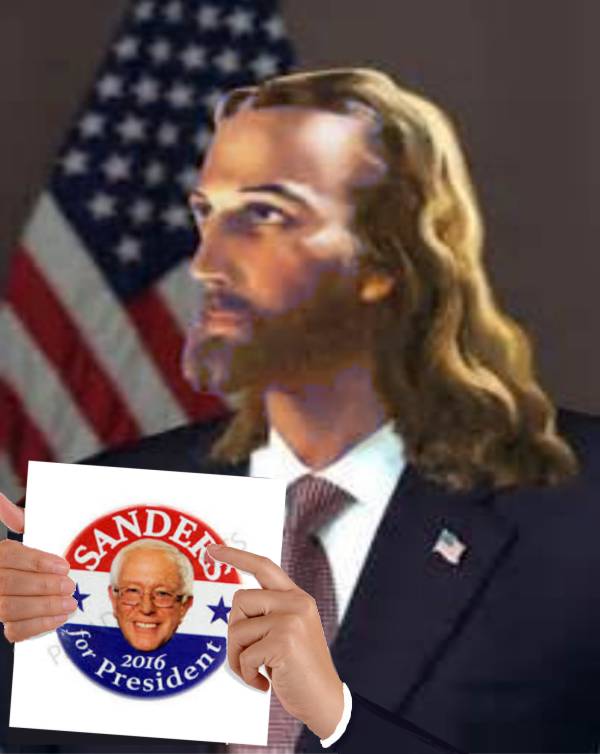
Jesus and Bernie Sanders

This one is going to be a doozy, so strap yourselves in if you want to take this ride.

I've seen multiple articles surface in the last few weeks attempting to explore the theological angles of economic redistribution, often couched within the framing question, "Was Jesus a Socialist?"  In some cases, these articles are explicitly aimed at Bernie Sanders and seem intended to provide a religious framework to justify Republican disdain for social safety nets.  After reading the third one today and being slapped in the face by fallacy after fallacy, I've reached the breaking point and I'm now obliged to explain why all of these "Jesus wasn't a socialist" articles are totally misguided.

First, the Argument: It's couched in many different scriptural references depending on which particular author you read, but it boils down to this:

  1. Socialism, as an organizing principles for governments, intends to abolish private property and redistribute wealth until everyone is "equal".  Like all governments, socialist governments will accomplish this through forceful coercion.
  2. Jesus wants to help the less fortunate willingly, out of the goodness of our hearts, not at gunpoint or under threat of sanction.
And... that's it.  In each of the arguments I've read, that's as far as it goes.  Besides a few glaring internal contradictions to the argument itself, the whole thing is nonsensical because of a tremendous disconnect between its first and second premise.

The main problem is that while it's true that Jesus doesn't ever say in the Bible that governments should redistribute wealth to help the poor, he doesn't say ANYTHING about what governments should or shouldn't do.  Jesus doesn't say governments should punish murderers or thieves or rapists.  Does that mean we should oppose laws designed to deter rape and murder because we should just not do those things out of the goodness of our hearts, rather than being coerced?  I don't know how Jesus might feel about that, but I, for one, don't want to live in that country.

If we look deeper into the context of this discussion, the Biblical argument further unravels.  For one thing, take a look at the first premise of the argument - it conflates certain totalistic interpretations of socialism (which, in fact, should be understood as a transitional state towards communism, and NOT a state with zero private property, but I digress) with social safety net programs in the United States.  It doesn't even make sense to imagine a world where private property doesn't exist and at the same time is re-distributed.  If private property is abolished, then no one has private property.  There's no re-distributing, because that would imply that people could receive and then take ownership of those distributions, which would require the existence of private property.

More importantly, there is no one on the political stage in the United States, including Bernie Sanders, who is advocating for the abolition of private property - at least not any more so than we already accept.  Bernie would probably raise taxes on certain segments of society to pay for more robust social safety nets - but this isn't an ideologically new proposal.  Bernie's not a socialist in the sense that these articles imply any more than any of the other Democratic or Republican candidates.  None of them is interested in abolishing taxation, nor the collective ownership of certain aspects of society, like public lands, roads, certain infrastructure, and so on.  These anti-socialist polemics couched in religious language set up a Straw Man.  You will see multiple scriptural references supporting the existence of private property, contracts, and so on.  That's all fine.  It has nothing to do with social safety nets (unless, again, you embrace the absolute position the private property is an absolute right, in which case, you're an anarchist, literally).

If you're looking for Biblical guidance on the role of government and how it relates to the individual ethical decisions of the people, here's a passage from Romans 13:

"For rulers are not a terror to good conduct, but to bad. Would you have no fear of the one who is in authority? Then do what is good, and you will receive his approval, for he is God's servant for your good. But if you do wrong, be afraid, for he does not bear the sword in vain. For he is the servant of God, an avenger who carries out God's wrath on the wrongdoer."

I'm no Biblical scholar, but the only reasonable interpretation I can see to the passage above is that, while we can hope that each individual will make proper moral decisions, government is necessary to intervene when people don't make moral decisions.  We can hope that people who possess much will do the right thing and give charitably to the poor, but the role government is to step in and punish when that doesn't happen.

If you prefer an Old Testament rationale, look the the story of the subjugation of the Hebrews by the Babylonians.  Why were God's chosen people subjected to this tyranny?  Because they didn't follow the word of God.  If we can't live as a national community that fulfills the aspirations of Christian Ethics, we need a coercive state to make that happen.


Stay tuned tomorrow for Part II: An analysis of the social and psychological origins of the "Jesus isn't a socialist" lines of argument.

Wednesday, September 23, 2015

Pope throws the Gauntlet

I'll put my cards on the table: I'm a big fan of Pope Francis.  I'm not Catholic myself, but my awareness of what the Pope has to say has increased since I married a Catholic.  Plus, it's not like the guy keeps a low profile.

He's been branded as a progressive reformer, pushing the Church's stances on issues of social and environmental justice.  He makes free market conservatives uncomfortable because he has increasingly and repeatedly focused a lens of the cruelties of capitalism, the failures of the market, the market forces' sheer indifference to destruction and suffering.  He said weapons manufacturers couldn't in good conscience call themselves Christians.  He released an encyclical scolding the Global North for reaping the benefits of massive environmental destruction whose impacts have primarily been experienced by the Global South.  He called Western materialism modern idol worship.

Seriously - this guy is calling everyone's nonsense and reminding everyone where the real heart of Christian values resides.  The most telling indicator of the truth and righteousness of the Pope's perspective, I think is the fact that his detractors have no substantive response to his arguments; read through the published reactions, and all you'll find is right-wing ad hominem, branding the pope a Marxist or liberation theologist (as if that were a bad thing), or describing his opinions as "too far beyond the pale" to merit serious consideration.

These are the strategies of indefensibly selfish, privileged beneficiaries of the Status Quo trying discredit the most respected person in the world pointing people eyes to the real human costs of leading thoughtless, materialistic, selfish lives.

The icing on the cake for this visit?  Pope Francis is entering the United States from Cuba, choosing both to visit that nation before the United States, and to enter from a country that has brought many undocumented immigrants to the shores of America.

So tell me, good Christian people of the world, when you step beyond the libel and name-calling, what exactly is the theological or moral issue with Francis' arguments?

Friday, September 11, 2015

Jesus v. Heisenberg

Kaleidoscopic Inspiration in Notre Dame.  trefpool.com

For those of you who may not know, I am a science teacher.  I work at a school with some religious affiliations, and for the last two years, I've offered a seminar that explored a tension point that divides our society and inspires a colorful collection epithets lobbed between the two camps:

Science vs. Religion.

Most people begin this conversation by advocating for the truth and importance of one of the contenders, which misses the point entirely.  The ideological conflict between these two institutions remains unresolved for most because neither side accepts the basic arguments made by other - there's no way to begin the conversation.  This is happening because people want to start their conversations in the middle, rather than at the beginning.

HERE is where the conversation begins: Science and Religion are both epistemological lenses - ways take the information around you and filter it into an interpretation of what the world really "is".  They have some important things in common, and some very important differences.

What could science and religion possibly share, you might ask? Most crucially, both are based on assumptions that can never be proven to be true.  Everything you've ever seen has been filtered through your eyes.  Everything you've ever heard has been filtered through your ears.  You have no way of verifying whether or not the images you see in front of you correspond to some kind of objective reality that actually exists.  Neither does anyone else - assuming other people actually do exist.  You don't know if you're plugged into the Matrix, or just a figment in the imagination of God.

This is a millennia-old philosophical quandary known as solipsism - the idea that we can't know what
Jesus power.  trefpool.com
is "real" because we can never look at reality from the outside, so to speak.  There is even a mathematical basis for solipsism: Goedel's Incompleteness Theorem demonstrates quite clearly that it is mathematically impossible to build a coherent, logical system without starting from basic, unprovable assumptions.  We glaze over these assumptions in our everyday lives because they're convenient, but convenience isn't the same thing as truth.

Did you hear that, militant atheists that belittle religious people for believing things?  Whether or not you realized it, your entire worldview is based on fundamental assumptions about the Universe that you will never, ever be able to prove, any more than a religious person can prove the existence of God.  We're all taking it on faith.  We all just believe whatever feels the most true to us.

Just some food for thought.

Wednesday, September 9, 2015

The Eternal Nugget: Do Assholes Have Souls?

I'm kicking myself for having lived in Atlanta for as long as I have and not having checked out the Decatur Book Festival until this year.  In fact, I wish I'd set aside twice as much time as I had to roam around and shop; I earmarked most of my time to listen to scheduled talks by authors.  The pinnacle of the experience was 45 minutes by the satire author Christopher Moore, whose discussion was closer to stand-up than NPR, but part of what he had to say really got me thinking, and that was when he was speculating about the difference between our corporeal bodies and whatever exists of us that is more eternal.

Any religious person with an imagination must have bumped up against this question before - when you go to heaven, which "you" is it?  Is heaven filled with old people?  What happens when you run into your multiple deceased spouses?

Even for the religiously uninitiated, I sense that there is some hesitation to embrace pure materialism - that is, to go all-in on the idea that all that constitutes us disappears when our material bodies die.  Those without a religious framework for conceptualizing such ideas have to search for some kind of universal ethics or inherent value of living things to justify the undercurrents bubbling through our ids that tell us something about our sentient consciousness is special.

Well, maybe this is one more example of a valuable observation about the Universe that leads us to live better lives that can be better understood and enacted by those who have embraced a religious mode of thinking.  Anchoring that transcendental nature of life in the backs of our minds as we walk through life would probably make us act nicer to each other, or be more forgiving to those assholes that pile slights upon us every day.

John Rawls, a 20th century ethicist, proposed a concept called "The Veil of Ignorance"; the gist is that the only way to devise a set of rules for society that would be truly fair would be to write them all out assuming that when you were done, we'd all be reincarnated into society with no prior knowledge of what our gender, ethnicity or social standing would be.  I haven't put my finger on it yet, but there something in all this talk of souls that hearkens back to the veil of ignorance; a reminder that, but for a thin gossimer layer that separates us from the mysteries on the other side of birth and death, we're all just feeble material manifestations of something more beautiful and eternal.